日常物品与玩具
这个场景教孩子认识身边常见的物品和玩具。
对话示例 1: 玩具
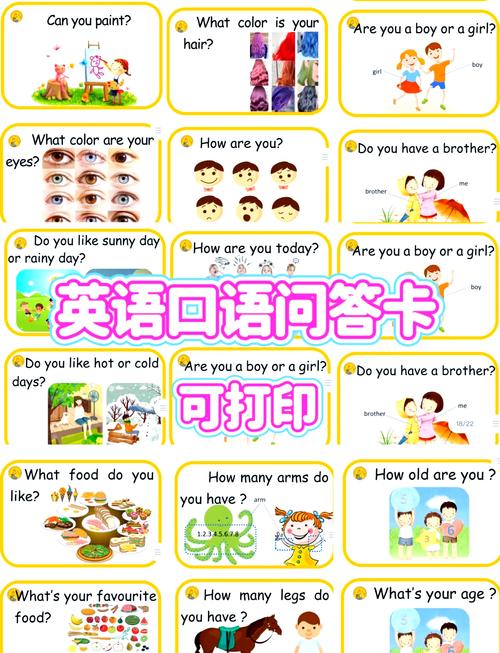
(图片来源网络,侵删)
- Parent: Look! What's this? (看!这是什么?)
- Child: It's a ball. (这是一个球。)
- Parent: Yes, it's a red ball. What color is it? (是的,是一个红色的球,它是什么颜色?)
- Child: It's red. (是红色。)
- Parent: Good job! Can you bounce the ball? (真棒!你能拍球吗?)
- Child: Yes! Bounce, bounce, bounce! (能!拍,拍,拍!)
核心句型:
- What's this? / What is this? (这是什么?)
- It's a [物品]. (这是一个……)
- What color is it? (它是什么颜色?)
- It's [颜色]. (是……颜色。)
- Can you [动词]? (你能……吗?)
常见词汇:
- Toys: ball (球), doll (娃娃), car (小汽车), teddy bear (泰迪熊), block (积木)
- Colors: red (红色), blue (蓝色), yellow (黄色), green (绿色)
家庭成员
这个场景帮助孩子学习如何称呼家人。
对话示例 2: 照片里的家人
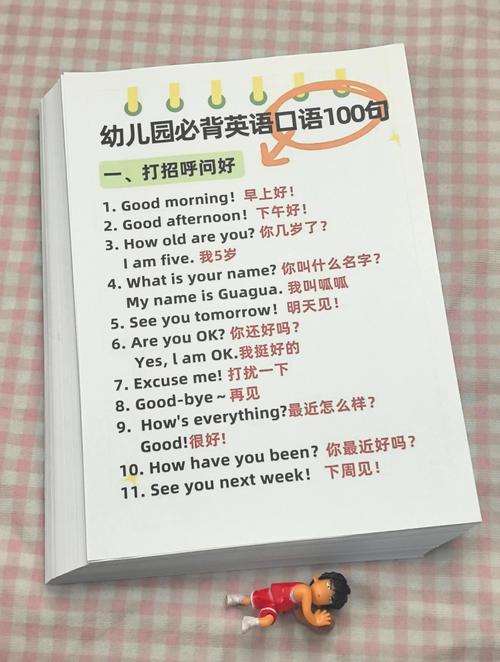
(图片来源网络,侵删)
- Parent: Lily, look at this photo. Who is this? (莉莉,看这张照片,这是谁?)
- Child: It's mommy! (是妈妈!)
- Parent: Yes! This is daddy. (是的!这是爸爸。)
- Child: Daddy! (爸爸!)
- Parent: And who is this little baby? (这个小宝宝是谁呀?)
- Child: It's me! (是我!)
- Parent: That's right! You are a cute baby. (没错!你是个可爱的小宝宝。)
核心句型:
- Look at this [物品]. (看这个……)
- Who is this? (这是谁?)
- It's [称呼]. (是……)
- That's right! / Correct! (没错!/ 对!)
常见词汇:
- Family: mommy (妈妈), daddy (爸爸), grandma (奶奶/外婆), grandpa (爷爷/外公), baby (宝宝), brother (哥哥/弟弟), sister (姐姐/妹妹)
食物与饮料
这个场景围绕孩子最感兴趣的食物展开。
对话示例 3: 想吃什么
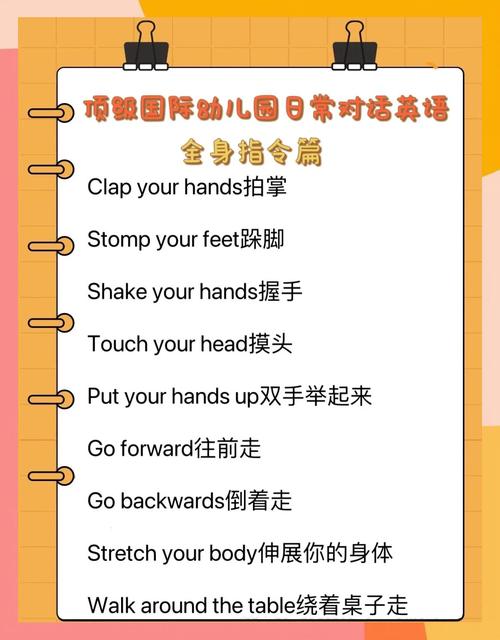
(图片来源网络,侵删)
- Parent: Are you hungry? (你饿了吗?)
- Child: Yes, I'm hungry. (是的,我饿了。)
- Parent: What do you want to eat? (你想吃什么?)
- Child: I want an apple. (我想要一个苹果。)
- Parent: An apple? Here you are. (苹果?给你。)
- Child: Thank you! Yummy! (谢谢!好吃!)
核心句型:
- Are you hungry/thirsty? (你饿了吗/渴了吗?)
- Yes, I am. / No, I'm not. (是的,我。/ 不,我不。)
- What do you want to eat/drink? (你想吃什么/喝什么?)
- I want a/an [食物/饮料]. (我想要一个……)
- Here you are. (给你。)
- Thank you! / Thanks! (谢谢!)
- Yummy! / Delicious! (好吃!)
常见词汇:
- Food: apple (苹果), banana (香蕉), bread (面包), cookie (饼干), egg (鸡蛋)
- Drinks: water (水), milk (牛奶), juice (果汁)
身体部位
这个场景通过互动游戏,让孩子认识自己的身体。
对话示例 4: "Simon Says" 游戏
- Parent: Simon says, "Touch your nose." (西蒙说,“摸摸你的鼻子。”)
- Child: (Touches nose) Nose! (摸鼻子) 鼻子!
- Parent: Good! Simon says, "Touch your eyes." (很好!西蒙说,“摸摸你的眼睛。”)
- Child: (Touches eyes) Eyes! (摸眼睛) 眼睛!
- Parent: Excellent! (太棒了!)
核心句型:
- Touch your [身体部位]. (摸摸你的……)
- This is my [身体部位]. (这是我的……)
- I have two [复数身体部位]. (我有两个……)
常见词汇:
- Body Parts: head (头), hair (头发), eye (眼睛), ear (耳朵), nose (鼻子), mouth (嘴巴), hand (手), foot (脚), arm (胳膊), leg (腿)
动物与叫声
这个场景结合动物名称和它们的叫声,非常有趣。
对话示例 5: 动物园
- Parent: Listen! What does the cat say? (听!猫怎么叫?)
- Child: Meow, meow. (喵,喵。)
- Parent: Yes! The cat says "meow". What does the dog say? (是的!猫“喵喵”叫,那狗怎么叫?)
- Child: Woof, woof! (汪,汪!)
- Parent: Good boy! And the duck? (好孩子!那鸭子呢?)
- Child: Quack, quack! (嘎,嘎!)
核心句型:
- What does the [动物] say? (……怎么叫?)
- The [动物] says [叫声]. (……“……”叫。)
- Look at the [动物]! (看那只……!)
常见词汇:
- Animals: cat (猫), dog (狗), duck (鸭子), bird (鸟), cow (奶牛), pig (猪), sheep (羊)
- Sounds: meow (喵), woof (汪), quack (嘎), moo (哞), oink (哼哧), baa (咩)
给家长和老师的小贴士
- 重复,重复,再重复: 幼儿通过重复来学习,不要怕把一句话说很多遍。
- 动作配合: 在说 "Touch your nose" 时,真的摸摸自己的鼻子,然后引导孩子一起做,TPR (Total Physical Response) 全身反应法对幼儿非常有效。
- 趣味第一: 用夸张的语气、可爱的表情和有趣的声音(比如模仿动物叫声)来吸引孩子的注意力。
- 积极鼓励: 无论孩子说得好不好,都要给予积极的反馈,"Good job!", "Excellent!", "Wow!",一个微笑或一个拥抱是最好的奖励。
- 融入生活: 在日常生活中随时创造对话机会,比如吃饭时问 "What do you want to eat?",出门时说 "Let's put on your shoes."。
- 保持简短: 每次对话不要太长,5-10分钟即可,以免孩子失去兴趣。
希望这些对话能帮助您和孩子们愉快地开启英语学习之旅!