Of course! Here is a comprehensive guide to Western dining etiquette, broken down into key sections with essential English vocabulary and phrases.
A Guide to Western Table Manners: Essential Etiquette & Vocabulary
Mastering Western table etiquette can seem complex, but it's mostly about showing respect to your host and fellow diners. Here’s a breakdown of the key rules.
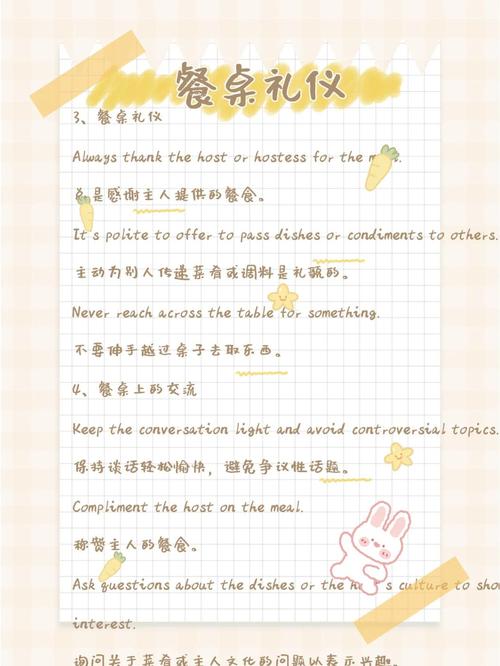
(图片来源网络,侵删)
Before the Meal: Seating and Napkins
Seating
- Wait to be seated. The host or hostess will usually direct you to your seat.
- If you are a guest, the seat of honor is typically to the right of the hostess or the left of the host. Don't just sit anywhere.
- Pull out your chair for the person of the opposite gender (or for anyone, as a general courtesy) before you sit down.
Napkins
- Place your napkin on your lap as soon as you are seated. This is the first and most important rule.
- Unfold it neatly without shaking it out.
- The purpose is to protect your clothes from spills and to use for wiping your hands or mouth.
- If you need to leave the table temporarily, place your napkin on the seat of your chair. This signals to the waiter that you are returning.
- When the meal is finished, place your napkin neatly on the left side of your plate. Do not refold it or crumple it into a ball.
Using Utensils: The Basics
In a formal setting, you will typically have a "place setting" with multiple forks, knives, and spoons. The general rule is to use utensils from the outside in.
The Place Setting (Left to Right)
- Forks: On the left side of the plate. Use them from the outermost to the innermost for each course.
- Knives and Spoons: On the right side of the plate. Use them from the outermost to the innermost.
- Dessert Utensils: Usually placed horizontally above the plate (a fork and spoon). Sometimes they are brought out with dessert.
How to Hold Utensils
- The American Style (Zig-Zag Method):
- Cutting: Hold the knife in your right hand and the fork in your left, with the tines pointing down.
- Eating: Put the knife down on the plate, transfer the fork to your right hand, and eat with the tines pointing up.
- The European Style (Continental Method):
- Cutting: Same as the American style.
- Eating: Keep the fork in your left hand and eat with the tines pointing down. This is more common in Europe and is often considered more efficient.
Key Utensil Rules
- "Resting Position" (Pause): If you want to pause during the meal (e.g., to chat), place your knife and fork on your plate in an inverted "V" or "A"** shape. The handles should be at 4 o'clock and the tips pointing at each other.
- "Finished Position": When you are completely done, place your knife and fork parallel on the plate, with the handles at 4 o'clock and the tines facing the 10 o'clock position. This signals to the waiter that you are finished.
- Never use a utensil for a purpose it wasn't intended for. Don't use your knife to spread butter (use the butter knife), or your fork to spear food (use your knife to help guide it onto the fork).
During the Meal: Eating and Behavior
Bread and Butter
- Break off a small piece of bread with your hands. Do not cut it with a knife.
- Butter only one small piece at a time.
- Butter is placed on the side of your bread plate. Your bread plate is on the left side of your main plate (use the "b and d" rule: bread is on the left, drink is on the right).
Soup
- Spoon away from you. Dip the spoon into the soup from the front and move it back.
- Spoon from the side of the bowl, not the front, to avoid splashing.
- Do not slurp. Bring the spoon to your mouth and sip quietly from the side of the spoon.
- When finished, place the soup bowl on the underplate, or leave it in the bowl with the spoon resting on it in the "finished position."
Using Your Hands
- Foods you can eat with your fingers: Bacon, sandwiches, pizza (if cut into slices), French fries, chips, small fruits like grapes or berries, and bread rolls.
- Foods you should never eat with your fingers: Asparagus, peas, artichokes, and anything messy like fried chicken (unless it's a casual setting like a BBQ).
General Rules of Behavior
- Chew with your mouth closed. This is fundamental.
- Do not talk with your mouth full.
- Do not season your food before you have tasted it. It's considered an insult to the cook.
- Reach politely. If you need something that is out of reach (like the salt or a dish), ask someone to pass it. Say, "Could you please pass the salt?" Never reach across someone's plate.
- Elbows off the table. Keep your elbows close to your sides while eating. You may rest your forearms on the table between courses, but not your elbows.
- Compliment the food. It's polite to thank your host or hostess for the meal.
Common English Phrases for Dining
Here are some useful phrases to know:
| English Phrase | Chinese Meaning / Context |
|---|---|
| "Please pass the [salt/bread]." | 请把[盐/面包]递给我。 (To ask for something) |
| "Could I get another glass of water, please?" | 请再给我一杯水好吗? (To request something) |
| "This is delicious! Thank you." | 太好吃了!谢谢你。 (To compliment the food) |
| "This is very kind of you." | 你真是太客气了。 (To thank your host) |
| "No, thank you. I'm full." | 不用了,谢谢,我饱了。 (To decline more food) |
| "It was a lovely meal. Thank you for having me." | 这顿饭太棒了,谢谢你邀请我。 (To thank your host at the end) |
| "Cheers!" | 干杯! (For a toast, usually with clinking glasses) |
Special Situations
- The Olive Pit: If you are eating olives, place the pit on your spoon and transfer it to your bread plate. Do not spit it on the table or the floor.
- Fish Bones: When eating fish, use your fork to gently lift the bone out and place it on the side of your plate.
- Dropping Your Utensil: If you drop a utensil on the floor, do not pick it up yourself. Simply ask the waiter for a new one. Say, "Could I have another knife, please?"
Quick Summary: Do's and Don'ts
| Do's (应该做的事) | Don'ts (不应该做的事) |
|---|---|
| Do put your napkin on your lap. | Don't tuck your napkin into your shirt. |
| Do wait for everyone to be served before eating. | Don't start eating before your host. |
| Do use your "inside-in" rule for utensils. | Don't make loud noises while eating or drinking. |
| Do compliment the food and your host. | Don't season your food before tasting it. |
| Do say "please" and "thank you." | Don't reach across the table. Ask to pass. |
| Do place used utensils on your plate, not the table. | Don't leave your napkin on the table when you leave. |
Remember, the most important part of any meal is the company. Being polite, respectful, and considerate will always leave a better impression than perfect knowledge of every single rule. Enjoy your meal

(图片来源网络,侵删)